
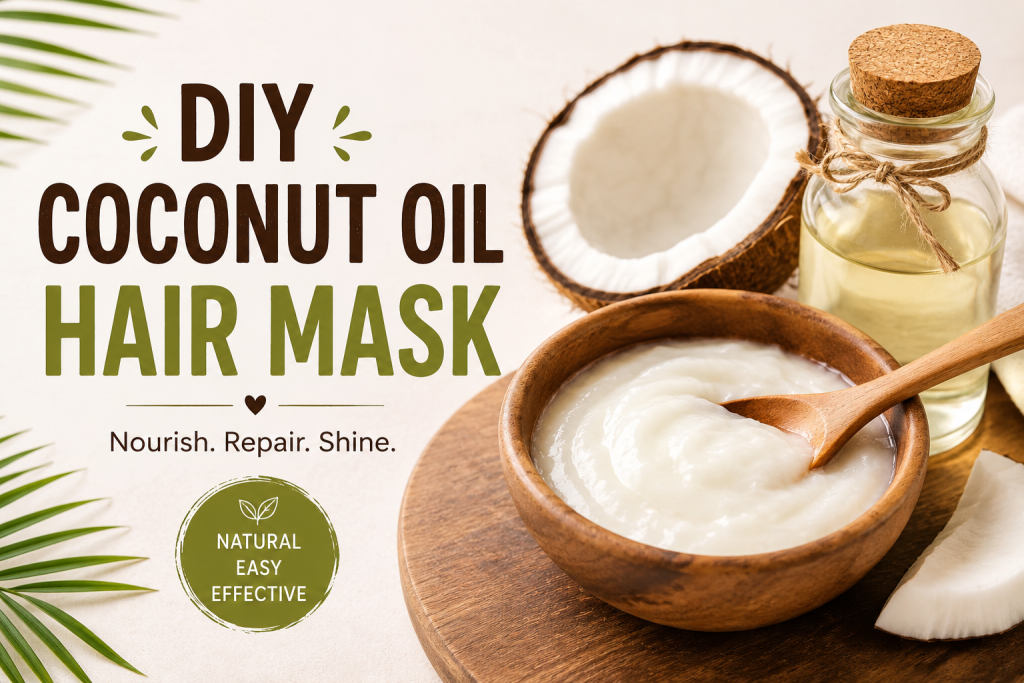
A coconut oil hair mask is one of the most effective natural treatments for restoring moisture, strength, and shine to damaged or dry strands. Unlike many other oils, coconut oil has a unique molecular structure that allows it to penetrate the hair shaft rather than just coating the surface, which is why dermatologists and trichologists frequently recommend it for hair repair.
If you’ve been dealing with frizz, breakage, or dullness, a well-formulated coconut oil hair mask can make a measurable difference within just a few applications. This guide covers the science behind why it works, how to use it correctly, and simple recipes you can try at home tonight.
Why Coconut Oil Works So Well on Hair?
Coconut oil is rich in lauric acid, a medium-chain fatty acid that binds easily with hair proteins. A widely cited 2003 study published in the Journal of Cosmetic Science compared coconut, mineral, and sunflower oils and found that coconut oil was the only one that significantly reduced protein loss in both damaged and undamaged hair, whether applied before or after washing.
This matters because:
- Protein loss is the main cause of hair weakness. When hair loses protein, it becomes brittle and prone to split ends.
- Surface coating isn’t enough. Oils that stay on the surface (like mineral oil) don’t prevent the swelling that leads to breakage.
- Lauric acid’s straight chain and low molecular weight let it slip into the hair cortex, reinforcing the internal structure.
How It Compares to Other Natural Oils?
| Oil | Penetrates Shaft? | Best For |
|---|---|---|
| Coconut oil | Yes | Protein retention, dry/damaged hair |
| Olive oil | Partially | Surface shine, mild softening |
| Argan oil | Minimal | Frizz control, lightweight sheen |
| Mineral oil | No | Temporary surface smoothness only |
Key Benefits of a Coconut Oil Hair Mask:
A regular coconut oil hair mask routine offers benefits that go beyond simple moisture:
- Deep hydration — Draws moisture into the hair shaft instead of sitting on top of it.
- Reduced breakage — Strengthens the internal protein structure, especially useful before and after heat styling or chemical treatments.
- Scalp support — Lauric acid has documented antimicrobial properties that may help manage flaking and minor scalp irritation.
- Improved shine — Smooths the hair cuticle, which reflects light more evenly.
- Natural detangling — Coats strands enough to reduce friction and knotting during brushing.
Coconut Oil Hair Mask for Dry Hair: What Makes It Different:
If your hair is chronically dry — often from over-washing, heat tools, or harsh weather — a coconut oil hair mask for dry hair typically needs a slightly richer formulation and longer processing time than a standard maintenance mask. Dry hair has a more porous cuticle, meaning it loses moisture faster but can also absorb treatments more readily if applied correctly. For best results, pair coconut oil with a humectant like honey or aloe vera, which helps lock moisture in rather than letting it evaporate.
Pros and Cons: An Honest Look:
Pros:
- Affordable and widely available
- No harsh chemicals or synthetic additives
- Backed by peer-reviewed research
- Works on multiple hair concerns (dryness, breakage, dullness)
Cons:
- Can weigh down fine or low-porosity hair if overused
- Requires thorough rinsing to avoid greasy buildup
- Not a substitute for protein treatments in severely chemically damaged hair
- Results build gradually, not overnight
Expert tip: If you have fine or oily hair, apply the mask only to mid-lengths and ends, avoiding the roots and scalp to prevent excess oiliness.
How to Apply a Coconut Oil Hair Mask (Step-by-Step)?
- Start with slightly damp hair. Damp strands absorb oil more evenly than fully dry or soaking wet hair.
- Warm 2–4 tablespoons of virgin coconut oil until it turns liquid (about 15–20 seconds in warm water, not the microwave).
- Section your hair into 3–4 parts for even distribution.
- Apply from mid-length to ends first, then work any remaining oil through the roots if your scalp needs it.
- Detangle gently with a wide-tooth comb to spread the product fully.
- Cover with a shower cap and leave on for 30–60 minutes. For a coconut oil hair mask for dry hair, extend this to 1–2 hours or apply overnight.
- Shampoo twice to fully remove the oil residue, then condition as usual.
- Rinse with cool water to seal the cuticle and boost shine.
Recommended Frequency:
- Dry or damaged hair: 1–2 times per week
- Normal hair: Once every 1–2 weeks
- Fine or oily hair: Every 2–3 weeks, ends only
Two Simple DIY Recipes:
1. Basic Repair Mask
- 3 tbsp virgin coconut oil
- 1 tbsp raw honey (humectant)
- Mix, warm slightly, apply for 45 minutes
2. Deep Moisture Mask for Dry Hair
- 3 tbsp coconut oil
- 1 tbsp aloe vera gel
- 2 drops rosemary essential oil (supports scalp circulation)
- Apply and leave on for 1 hour or overnight under a cap
Real-World Example
Many licensed cosmetologists incorporate coconut oil pre-shampoo treatments for clients preparing for color or keratin services. The oil forms a protective barrier that reduces protein loss during chemical processing, which is one reason salons increasingly recommend an at-home coconut oil hair mask in the two weeks leading up to a treatment. Clients who follow this routine consistently report less breakage and a smoother processing experience.
Common Mistakes to Avoid
- Using too much oil — More isn’t better; excess oil is harder to rinse out and can cause buildup.
- Applying to bone-dry hair — Reduces absorption efficiency.
- Skipping the double shampoo — Leftover oil attracts dust and weighs hair down over time.
- Using refined coconut oil — Virgin or cold-pressed coconut oil retains more lauric acid and nutrients than refined versions.
A coconut oil hair mask is a science-backed, low-cost way to repair damage, boost shine, and restore moisture to tired strands. Whether you’re managing everyday dryness or recovering from heat and chemical damage, a coconut oil hair mask for dry hair — applied consistently and rinsed thoroughly — can noticeably improve hair health within a few weeks. Start with once-weekly applications, adjust based on your hair type, and pair it with gentle detangling for the best long-term results.
Frequently Asked Questions:
1. How often should I use a coconut oil hair mask? Most hair types benefit from applying a coconut oil hair mask once or twice a week. Fine or oily hair should stick to every 2–3 weeks, focusing on the ends only.
2. Can I leave a coconut oil hair mask on overnight? Yes, especially a coconut oil hair mask for dry hair. Cover your hair with a silk scarf or shower cap to protect your pillow and enhance absorption, then double-shampoo in the morning.
3. Does Coconut oil hair mask work on all hair types? It works best on medium-to-thick, dry, or damaged hair. Fine or low-porosity hair may find it too heavy unless applied sparingly to the ends.
4. Should I apply coconut oil to wet or dry hair? Slightly damp hair is ideal. It allows better absorption than fully dry hair while avoiding the dilution that occurs with soaking wet hair.
5. Is virgin coconut oil better than refined for a hair mask? Yes. Virgin or cold-pressed coconut oil retains more lauric acid and natural nutrients, making it more effective for penetrating the hair shaft compared to refined coconut oil.
7 DIY Hair Masks for Dry, Damaged, Frizzy + Oily Hair
Homemade Hair Mask for Hair Growth and Thickness: 7 Easy DIY Recipes That Actually Work
