
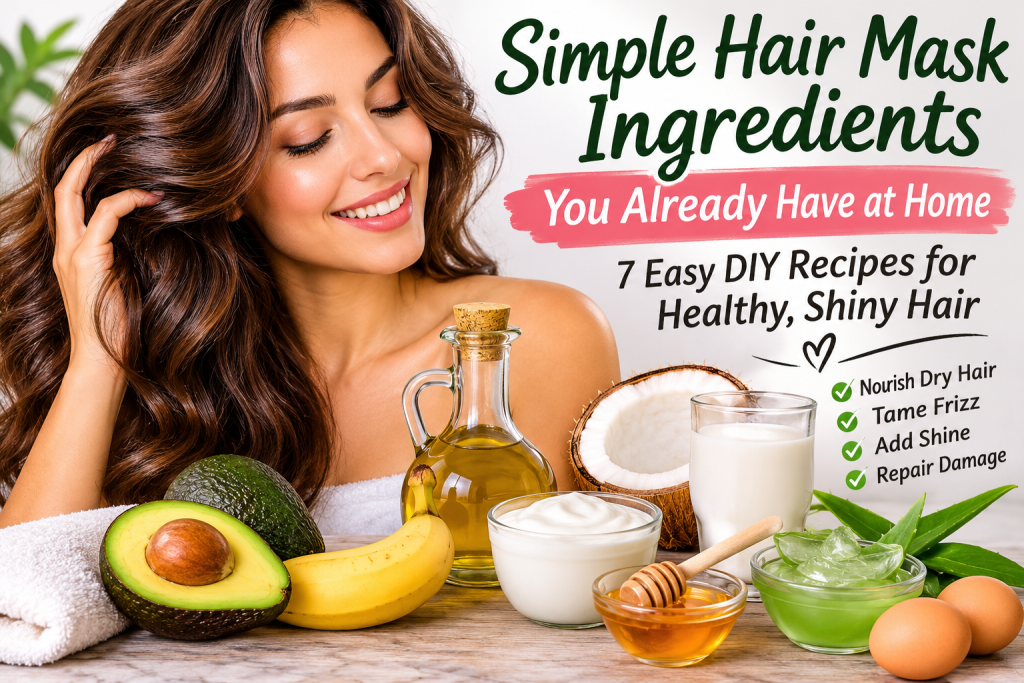
Discover 7 simple hair mask ingredients you already have at home. Try easy DIY hair masks for dry, frizzy, dull, and damaged-looking hair.
Discover 7 simple hair mask ingredients you already have at home. Try easy DIY hair masks for dry, frizzy, dull, and damaged-looking hair.
You don’t always need expensive hair treatments to give your hair a little extra care. Sometimes, some of the simplest hair mask ingredients are already sitting in your kitchen.
Ingredients like avocado, olive oil, honey, yogurt, banana, and coconut milk can be used to make easy homemade hair masks that help condition dry hair, improve softness, and make frizzy strands look smoother and shinier.
If your hair feels dry, looks dull, or becomes puffy and difficult to manage, trying a simple DIY hair mask can be an affordable addition to your weekly hair-care routine.
I personally like using a combination of egg, olive oil, and yogurt. After using this mixture, I noticed that my hair looked shinier, smoother, and less damaged. It also made my wavy hair look more relaxed and manageable.
The best part? You don’t need a complicated recipe or a long list of ingredients.
In this guide, you’ll discover seven accessible ingredients, easy homemade hair mask recipes, how to apply them, and common mistakes to avoid.
1. Seven Simple Hair Mask Ingredients You Already Have at Home
Before preparing your homemade hair treatment, it’s helpful to understand what different kitchen ingredients can do for your hair.
Here are seven affordable options worth considering.
1. Avocado: For Dry and Rough Hair
Avocado is rich in natural oils and fatty acids. Its creamy texture makes it a popular ingredient in homemade conditioning masks.
It can help soften dry hair, improve the appearance of rough ends, and make strands easier to manage.
Why use it?
- Helps condition dry hair.
- Adds softness to rough-looking lengths.
- Makes hair feel smoother.
- Works well in combination with olive oil or yogurt.
Best for: Dry, coarse, and damaged-looking hair.
2. Olive Oil: For Dry and Frizzy Hair
Olive oil is one of the easiest ingredients to find in most kitchens. It contains fatty acids and antioxidants and can help lubricate the hair shaft.
When used in small amounts, it can make dry lengths feel softer and reduce friction that contributes to breakage.
Why use it?
- Helps soften dry hair.
- Adds shine.
- Helps smooth the appearance of frizz.
- Makes rough lengths feel more manageable.
Best for: Dry, thick, coarse, and frizzy hair.
Tip: Start with a small amount. Too much olive oil can leave fine hair greasy and difficult to wash.
3. Coconut Oil: For Dry Hair and Breakage
Coconut oil is a popular ingredient in hair care because it contains lauric acid, which can penetrate the hair shaft more effectively than many other oils.
Research suggests that coconut oil can help reduce protein loss from hair, particularly when used as a pre-wash treatment.
Why use it?
- Helps reduce protein loss.
- Lubricates dry hair.
- Helps reduce friction during washing and styling.
- Makes hair feel softer.
Best for: Dry, thick, coarse, and damaged-looking hair.
4. Yogurt: For Soft and Smooth Hair
Plain, unsweetened yogurt has a creamy consistency that makes it easy to incorporate into homemade hair masks.
It helps distribute other ingredients evenly and provides a conditioning texture that can leave hair feeling softer after rinsing.
Why use it?
- Adds a creamy consistency to DIY masks.
- Helps soften hair.
- Combines easily with olive oil and avocado.
- Makes homemade treatments easy to spread.
Best for: Hair that feels dry, rough, or difficult to manage.
5. Banana: For Softness and Manageability
Bananas contain carbohydrates, vitamins, and minerals. They are often used in DIY hair masks because of their soft, creamy texture.
When blended properly, banana can help create a conditioning mask that leaves hair feeling softer.
Why use it?
- Helps condition hair.
- Adds softness.
- Makes dry lengths feel more manageable.
- Combines well with coconut milk or honey.
Best for: Dry, rough, and frizzy hair.
Important: Blend the banana until completely smooth. Small pieces can stick to your hair and become difficult to rinse out.
6. Aloe Vera: For Lightweight Conditioning
Aloe vera gel is commonly used in hair-care routines because of its lightweight texture and moisturizing properties.
It can be a good option if you prefer a less oily homemade treatment.
Why use it?
- Provides lightweight conditioning.
- Helps hair feel softer.
- Can make frizzy lengths easier to manage.
- Works well with coconut milk.
Best for: Hair that needs lightweight conditioning without a heavy oil-based mask.
Use pure aloe vera gel rather than products containing alcohol or strong fragrances. If using fresh aloe, remove the yellow latex and use only the clear inner gel.
7. Coconut Milk: For Dry and Frizzy Hair
Coconut milk has a creamy texture and contains fats that make it a useful ingredient in DIY conditioning masks.
It can help soften dry hair and make rough lengths feel smoother.
Why use it?
- Helps condition dry lengths.
- Adds softness.
- Makes homemade masks easier to spread.
- Combines well with banana and aloe vera.
Best for: Dry, frizzy, and coarse hair.
2. Seven Easy Homemade Hair Mask Recipes
Now that you know which ingredients you can use, let’s put them together into simple DIY hair treatments.
These recipes use accessible ingredients and don’t require expensive equipment.
Recipe 1: Egg, Olive Oil, Yogurt, and Avocado Hair Mask
Best for: Dry, frizzy, dull, and damaged-looking hair.
This is my favorite combination because it brings together four ingredients with different conditioning properties.
I have personally used egg, olive oil, and yogurt together and noticed that my hair looked shinier, smoother, and less damaged. Adding avocado makes the mixture richer and particularly suitable for dry lengths.
Ingredients:
- 1 egg
- 1 tablespoon olive oil
- 2 tablespoons plain yogurt
- ½ ripe avocado
Instructions:
- Mash the avocado until smooth.
- Add the egg, olive oil, and yogurt.
- Mix everything until you get a creamy consistency.
- Apply the mixture to damp hair, focusing on the lengths and ends.
- Leave it on for approximately 20–30 minutes.
- Rinse thoroughly with cool or lukewarm water.
- Shampoo your hair afterward.
Why you’ll love it: This combination can help condition dry hair, improve softness, and give dull-looking lengths a smoother appearance.
Recipe 2: Banana and Coconut Milk Hair Mask
Best for: Dry, rough, and frizzy hair.
If your hair feels rough or becomes puffy after washing, this creamy combination is worth trying.
Ingredients:
- 1 ripe banana
- 3 tablespoons coconut milk
Instructions:
- Cut the banana into small pieces.
- Blend it with the coconut milk until completely smooth.
- Apply to damp hair, concentrating on the lengths.
- Leave for 20–30 minutes.
- Rinse thoroughly and shampoo.
Why you’ll love it: The combination provides a creamy conditioning treatment that can help soften dry strands and improve manageability.
Recipe 3: Olive Oil and Honey Hair Mask
Best for: Dry, dull, and frizzy hair.
Honey is a humectant, meaning it attracts and retains moisture. Combined with olive oil, it creates a simple conditioning mixture.
Ingredients:
- 1 tablespoon olive oil
- 1 tablespoon honey
Instructions:
- Mix the olive oil and honey.
- Apply a thin layer to damp hair.
- Focus on the mid-lengths and ends.
- Leave for 20 minutes.
- Rinse thoroughly and shampoo.
Why you’ll love it: This simple combination can help soften rough lengths and improve the appearance of dry, dull hair.
Recipe 4: Aloe Vera and Coconut Milk Hair Mask
Best for: Frizzy hair that needs lightweight conditioning.
Not everyone enjoys heavy oil-based hair treatments. If you prefer something lighter, try this combination.
Ingredients:
- 2 tablespoons pure aloe vera gel
- 3 tablespoons coconut milk
Instructions:
- Combine the aloe vera gel and coconut milk.
- Mix until smooth.
- Apply to damp hair.
- Leave for 20–30 minutes.
- Rinse and shampoo as usual.
Why you’ll love it: Both ingredients create a lightweight conditioning mixture that can help hair feel softer and easier to manage.
Recipe 5: Avocado and Coconut Oil Hair Mask
Best for: Very dry and coarse hair.
If your hair feels particularly dry, this richer combination may be a better option.
Ingredients:
- ½ ripe avocado
- 1 teaspoon coconut oil
Instructions:
- Mash the avocado until completely smooth.
- Add the coconut oil.
- Mix thoroughly.
- Apply to damp hair, concentrating on dry lengths and ends.
- Leave for 20–30 minutes.
- Rinse thoroughly and shampoo.
Why you’ll love it: Avocado and coconut oil provide a rich conditioning combination that can leave coarse hair feeling softer.
Recipe 6: Yogurt and Olive Oil Hair Mask
Best for: Dry, dull, and rough hair.
This is one of the simplest homemade hair masks because it requires only two common ingredients.
Ingredients:
- 3 tablespoons plain yogurt
- 1 tablespoon olive oil
Instructions:
- Mix both ingredients in a small bowl.
- Apply to damp hair.
- Distribute evenly through the lengths.
- Leave for 20–30 minutes.
- Rinse thoroughly and shampoo.
Why you’ll love it: It’s an easy way to add a conditioning step to your weekly hair-care routine without buying additional products.
Recipe 7: Banana and Aloe Vera Hair Mask
Best for: Dry, frizzy, and difficult-to-manage hair.
This combination is ideal if you want to try a homemade mask without adding too much oil.
Ingredients:
- 1 ripe banana
- 2 tablespoons pure aloe vera gel
Instructions:
- Blend the banana until completely smooth.
- Add the aloe vera gel.
- Mix until creamy.
- Apply to damp hair.
- Leave for 20 minutes.
- Rinse thoroughly and shampoo.
Why you’ll love it: This creamy mixture can help condition dry lengths and leave hair feeling softer.
3. How to Apply a Homemade Hair Mask Correctly
Choosing good ingredients is only one part of an effective hair-care routine. How you apply your mask also matters.
Follow these simple steps to get the most out of your homemade treatment.
Step 1: Start with damp hair
Lightly dampen your hair before applying the mask. This helps distribute the mixture more evenly.
Step 2: Divide your hair into sections
If you have thick or long hair, divide it into several sections to make application easier.
Step 3: Focus on the lengths and ends
Apply the mixture mainly to the mid-lengths and ends. These areas are often drier and more exposed to heat styling and environmental damage.
Step 4: Leave it on for the recommended time
Most of these recipes can be left on for around 20–30 minutes. There is no need to leave a homemade mask on for several hours.
Step 5: Rinse thoroughly
Use cool or lukewarm water, especially when using an egg-based mask. Hot water can cook the egg and make it difficult to remove.
Step 6: Shampoo and condition
Wash your hair with a suitable shampoo and follow with conditioner if needed.
4. How Often Should You Use Homemade Hair Masks?
For most people, using a homemade hair mask once a week is a reasonable starting point.
You don’t need to apply several different masks every few days to get better results.
Consistency is more important than constantly changing your hair-care routine.
Here is a simple weekly schedule:
| Day | Hair-care routine |
|---|---|
| Wash day | Apply one homemade mask before shampooing |
| After rinsing | Shampoo and condition |
| Between washes | Use a suitable leave-in conditioner if needed |
| Throughout the week | Minimize excessive heat styling |
Pay attention to how your hair responds. If it feels greasy, heavy, or coated, reduce the amount of oil or use a lighter recipe.
5. Common Mistakes to Avoid When Making DIY Hair Masks
Homemade hair treatments are simple, but a few mistakes can make them less enjoyable or difficult to use.
Here are some things to avoid.
1. Using too much oil
Adding more oil doesn’t automatically mean better results. Too much can leave your hair greasy and weighed down.
2. Applying every mask to the scalp
Most of these recipes are designed for conditioning the hair lengths. If you have an oily or sensitive scalp, avoid applying rich mixtures directly to it.
3. Leaving the mask on for too long
Keeping a homemade mask on for hours doesn’t guarantee better results. Follow the recommended application time.
4. Not blending ingredients properly
Banana and avocado can leave small pieces in your hair. Use a blender or food processor to achieve a completely smooth consistency.
5. Using hot water with egg masks
Hot water can cook the egg and make rinsing unpleasant. Always use cool or lukewarm water.
6. Ignoring allergies and sensitivities
Natural ingredients can still cause allergic reactions or irritation. Avoid ingredients you’re allergic to and perform a small patch test before using a new mixture.
7. Preparing large quantities in advance
Homemade masks contain fresh food ingredients and don’t have the preservatives used in commercial products. Prepare only what you need and discard leftovers rather than storing them for future applications.
6. Are Homemade Hair Masks Better Than Store-Bought Hair Masks?
Not necessarily. Both have their place in a good hair-care routine.
Homemade hair masks are useful when you want an affordable conditioning treatment using ingredients you already have at home.
However, commercial hair masks offer some advantages. They are formulated with specific ingredients, have controlled textures, and are generally more convenient to use.
For example, a formulated hair mask may contain conditioning agents that improve detangling and reduce friction, while a homemade avocado mask offers a simpler conditioning experience.
My advice is to use whichever option fits your schedule and hair-care needs.
If you have the ingredients and enough time, try a homemade mask. If you’re busy or don’t have the ingredients available, a good commercial hair mask is perfectly fine.
You don’t have to choose only one.
7. Don’t Forget Your Shampoo and Conditioner
One important thing to remember: homemade hair masks shouldn’t replace your regular hair-care products.
Even if you enjoy making DIY treatments, investing in a good shampoo and conditioner suitable for your hair type is essential.
A simple hair-care routine can include:
- Shampoo: Choose one that cleans your scalp without leaving your hair feeling excessively dry.
- Conditioner: Use it after washing to improve softness and detangling.
- Hair mask: Add a homemade or commercial treatment once a week, depending on your hair’s needs.
- Heat protection: Apply a suitable heat protectant before using hot styling tools.
- Leave-in conditioner: Consider one if your hair is particularly dry or frizzy.
Also, try to reduce excessive heat styling. Frequent use of straighteners, curling irons, and high-temperature blow-drying can contribute to dryness and breakage.
Remember that even the best hair mask cannot permanently repair split ends or reverse all existing hair damage.
8. Frequently Asked Questions About Homemade Hair Masks
What are the best ingredients for a homemade hair mask?
Some popular ingredients include avocado, olive oil, coconut oil, yogurt, banana, aloe vera, and coconut milk.
Each offers different conditioning properties, so choose ingredients according to your hair’s needs.
Can I use a homemade hair mask every day?
Daily use isn’t necessary. Once a week is a good starting point for most hair types. Using rich oil-based masks too frequently can leave hair feeling heavy or greasy.
Are homemade hair masks good for frizzy hair?
They can help improve softness, reduce friction, and make frizzy hair look smoother and more manageable.
However, results vary depending on hair type, porosity, and the ingredients used.
Can homemade hair masks repair damaged hair?
Homemade masks can improve the appearance and feel of damaged hair by conditioning dry lengths and reducing friction.
However, they cannot permanently repair split ends or restore hair that has suffered significant structural damage.
Should I apply a hair mask to wet or dry hair?
Applying most of these homemade masks to damp hair makes them easier to distribute evenly.
Always follow the instructions for your particular recipe.
How long should I leave a homemade hair mask on?
Around 20–30 minutes is sufficient for the recipes in this guide. Leaving them on longer doesn’t necessarily provide additional benefits.
Can I use olive oil and egg on my hair?
Yes, provided you aren’t allergic to either ingredient. They are commonly combined in homemade conditioning masks.
Apply the mixture to the hair lengths, avoid hot water when rinsing, and shampoo afterward.
Do homemade hair masks help hair grow faster?
There isn’t good scientific evidence that kitchen-based hair masks directly accelerate hair growth.
However, conditioning treatments may help reduce breakage, allowing you to retain more of your existing hair length.
Final Thoughts
Taking care of your hair doesn’t always have to be expensive or complicated.
Sometimes, simple ingredients you already have at home can become useful additions to your weekly hair-care routine.
Whether you choose avocado, olive oil, yogurt, banana, coconut milk, or aloe vera, the important thing is to understand what your hair needs and avoid overdoing treatments.
From my experience, consistency, patience, choosing suitable ingredients, and limiting excessive heat styling are much more important than trying a new hair treatment every few days.
Start with one simple recipe, see how your hair responds, and build a routine that works for you.
Beautiful, healthy-looking hair is not about using the most expensive products. It’s about giving your hair the right care consistently.
Discover:Homemade Hair Mask for Hair Growth and Thickness
Female Hair Loss Treatment Shampoo
Best Natural Treatments for Hair Thinning That Actually Work
